
The global fashion industry is facing a waste crisis that is growing faster than almost any other consumer sector. Every second, the equivalent of a garbage truck full of textiles is landfilled or burned somewhere in the world. What was once a seasonal retail cycle has evolved into an ultra-fast fashion economy driven by cheap synthetic fibres, disposable trends, and relentless overproduction.
The result is a recycling problem unlike almost any other industrial waste challenge.
According to the European Environment Agency (EEA), the EU generated approximately 6.95 million tonnes of textile waste in 2020 — around 16kg per person. Only 4.4kg per person was collected separately for reuse or recycling, while the majority ended up in mixed waste streams.
Globally, the numbers are even more alarming. Industry estimates suggest the world produces around 92 million tonnes of textile waste every year, yet less than 1% of textiles are recycled back into new clothing. Most discarded garments are incinerated, exported overseas, or buried in landfill sites.
For decades, textile recycling remained fragmented, labour-intensive, and economically weak. But mounting environmental pressure, stricter regulations, and rapid advances in artificial intelligence are beginning to force change across the sector.
Technologies such as hyperspectral imaging, AI-powered sorting systems, and chemical fibre recycling may determine whether the fashion industry can transition toward a circular economy — or whether textile waste becomes one of the defining environmental disasters of the next twenty years.
The Scale of the Textile Waste Problem
The textile industry produces enormous amounts of waste because modern fashion is built on volume and speed. Global clothing production has roughly doubled over the last two decades, while garment utilisation has declined dramatically. Consumers now buy more clothes than ever before but wear them fewer times before disposal.
Fast fashion has accelerated the problem in several ways:
- Clothing is cheaper and lower quality than ever before
- Consumers buy significantly more garments each year
- Synthetic fibres such as polyester dominate production
- Garments are increasingly made from blended materials
- Textile collection systems remain inconsistent globally
The environmental consequences are severe. Synthetic textiles release microplastics into oceans and waterways, while decomposing garments emit greenhouse gases. Incineration reduces landfill use but creates emissions and destroys potentially reusable material.
A recent Vogue investigation described Europe’s recycling system as dangerously fragile, arguing that much of today’s “recycling” is actually a global redistribution network that delays disposal rather than genuinely recycling textiles into new garments.
Meanwhile, consumers are becoming increasingly aware of the problem. In a protest campaign highlighted by Wendy Ward in The Guardian, people began mailing worn-out clothes back to retailers to expose the lack of meaningful end-of-life solutions for fashion products.
Ward argued that fashion brands have built profitable business models around disposability while avoiding responsibility for what happens after garments are discarded.
Why Textile Recycling Is So Difficult
Unlike glass, aluminium, or paper, textiles are extraordinarily difficult to recycle at scale.
The biggest challenge is fibre blending.
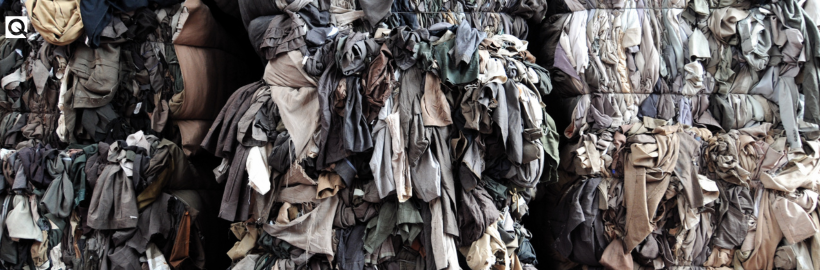
Modern garments are rarely made from a single pure material. A typical piece of clothing may combine cotton, polyester, elastane, nylon, viscose, dyes, coatings, stitching, buttons, and chemical finishes — all fused together in one product.
Cotton-polyester blends dominate modern fashion because they combine comfort, durability, stretch, and low production costs. But these blends are notoriously difficult to separate economically during recycling.
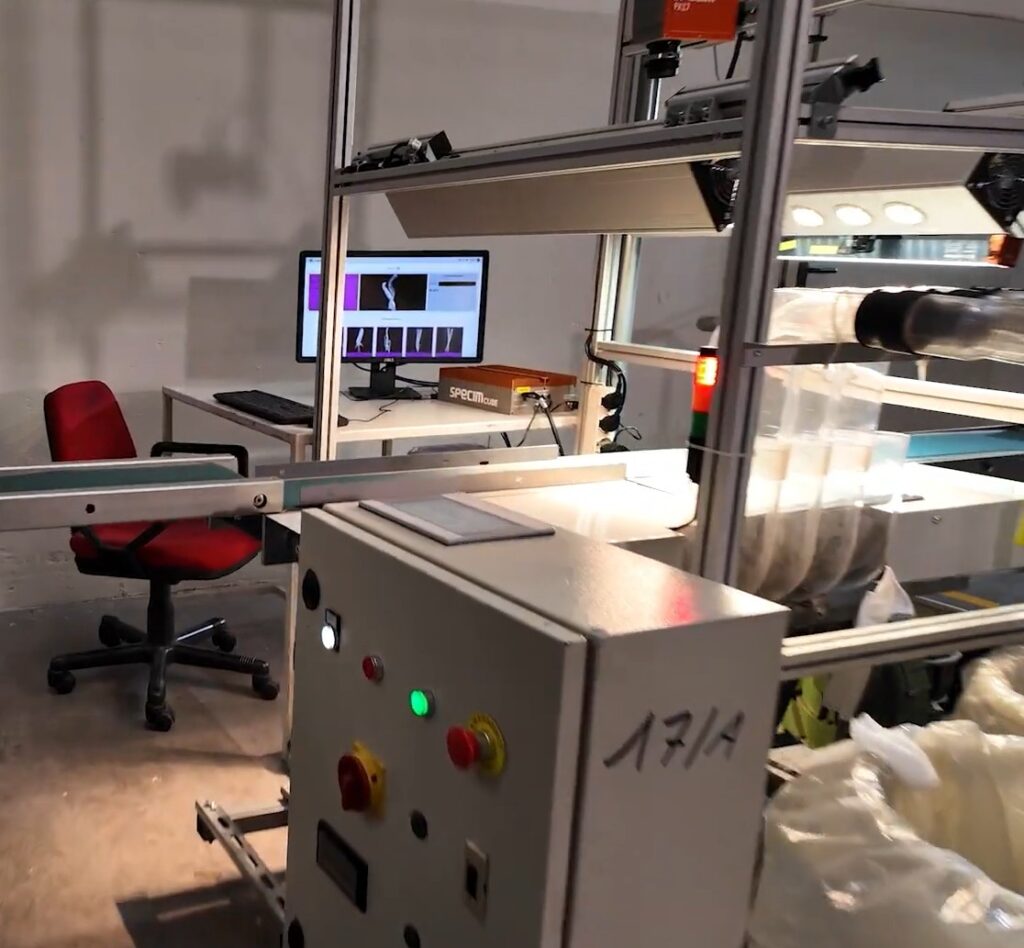
Traditional recycling facilities still rely heavily on manual labour. Workers inspect garments visually and sort them by fibre type, colour, or quality. But even experienced operators struggle to identify complex blends accurately, especially when fabrics are dyed, faded, stretched, or chemically treated.
This creates several major problems:
1. Poor Sorting Accuracy
Manual sorting is inconsistent and difficult to scale. Contaminated recycling streams reduce material quality and make fibre-to-fibre recycling significantly harder.
2. Economic Viability
Virgin polyester and cotton are often cheaper than recycled alternatives because global raw-material supply chains are highly optimised.
As a result, many recycling facilities operate on extremely thin margins.
3. Automation Limitations
Conventional optical sorting systems struggle with dark fabrics, heavily dyed garments, and blended fibres. Standard RGB machine vision systems can detect colour and shape but not chemical composition.
4. Downcycling Instead of True Recycling
Much of today’s textile “recycling” is actually downcycling. Old garments are shredded into insulation, industrial cloths, mattress filling, or low-grade material rather than converted back into high-quality textile fibres.
True fibre-to-fibre recycling remains relatively rare because contamination levels are often too high.

How Bad Could the Problem Get?
If current consumption patterns continue, textile waste could become one of the defining environmental problems of the next two decades.
Several trends suggest the situation may worsen significantly before improving:
- Global clothing consumption continues rising
- Ultra-fast fashion shortens garment lifespans further
- Synthetic fibre production is accelerating
- Landfill restrictions are tightening
- Developing nations are receiving increasing volumes of exported textile waste
- Recycling infrastructure is failing to scale fast enough
From 2025 onward, EU member states have been legally required to implement separate textile waste collection systems under the Waste Framework Directive. While the UK is no longer legally bound by the EU’s legislative updates or the EEA agreement, the UK’s domestic waste policies are designed to mirror the core principles of the EU framework.
This will dramatically increase the volume of textiles entering recycling facilities.
But there is a major problem: the infrastructure is not ready.
Many operators already face labour shortages, inconsistent sorting quality, and weak profitability. As collection rates rise, manual systems may become economically unsustainable. Without major advances in sorting efficiency and automation, the industry could face a scenario where collection volumes rise faster than recycling capacity — leading to increased stockpiling, incineration, and landfill overflow.
The Rise of Intelligent Textile Sorting
One of the most promising developments in textile recycling is the emergence of intelligent sorting systems powered by AI and hyperspectral imaging.
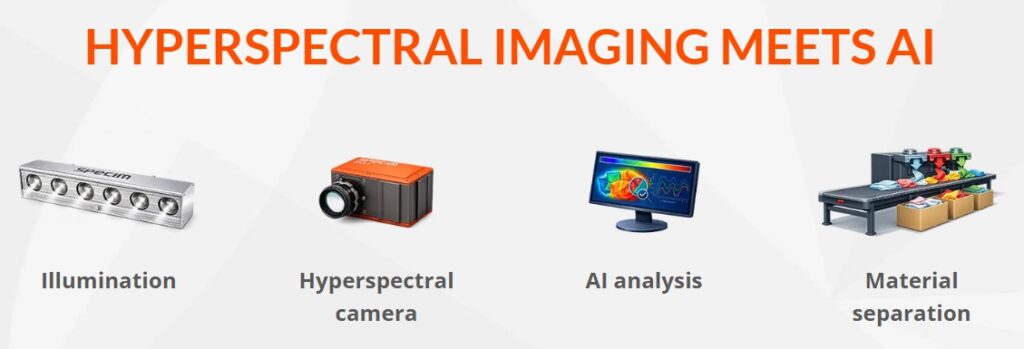
Unlike standard machine vision systems, hyperspectral imaging analyses materials across many wavelengths of light beyond the visible spectrum. Every fibre type reflects light differently, creating a unique “spectral fingerprint.”
This allows machines to identify the chemical composition of fabrics in real time rather than simply recognising colour or appearance.
Hyperspectral imaging offers several major advantages:
- Detection of fibre composition at industrial speed
- Identification of blended fabrics
- Improved sorting purity
- Reduced labour dependency
- Better detection of impurities
- Compatibility with automated conveyor systems
Researchers increasingly believe hyperspectral imaging could become foundational infrastructure for large-scale textile recycling.
A 2025 academic study on near-infrared textile classification concluded that deep learning combined with hyperspectral imaging showed “robust generalisation” under industrial conditions and could significantly improve recycling accuracy.
Another study describing an “Autonomous AI-enabled Industrial Sorting Pipeline” found that combining robotics, spectral imaging, and AI classification could dramatically improve scalability and efficiency in textile recycling systems.
Specim RETEX and the Next Generation of Recycling Technology
One of the most important commercial examples of this trend is Specim RETEX, introduced by Specim in 2026.
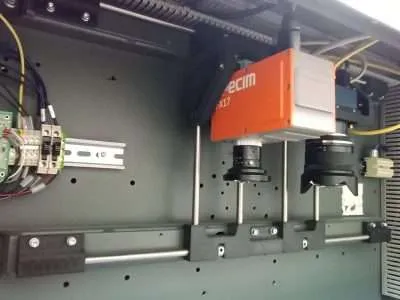
RETEX combines hyperspectral imaging with artificial intelligence to automatically identify textile materials, blended fibres, and impurities at industrial speed.
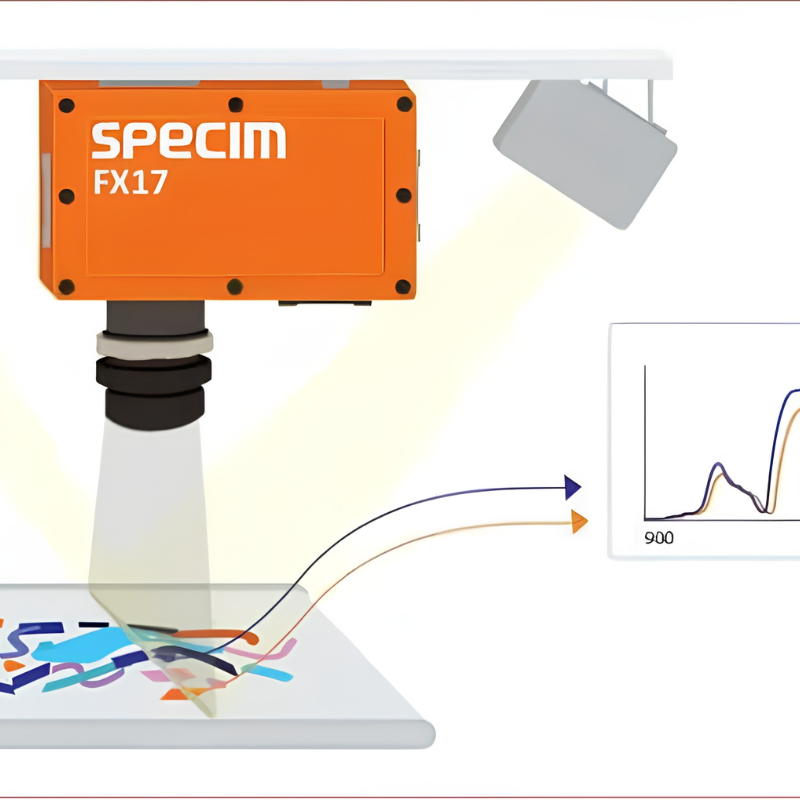
The system can detect materials including:
- Cotton
- Polyester
- Polyamide
- Viscose
- Wool
- Acrylic
- Elastane blends
- Cotton-polyester blends
Unlike conventional optical systems, RETEX does not rely on visual similarity. Instead, it analyses spectral signatures at the chemical level
According to Specim, the technology can achieve over 95% sorting accuracy while handling dark fabrics and complex blended garments that traditional systems struggle to classify.
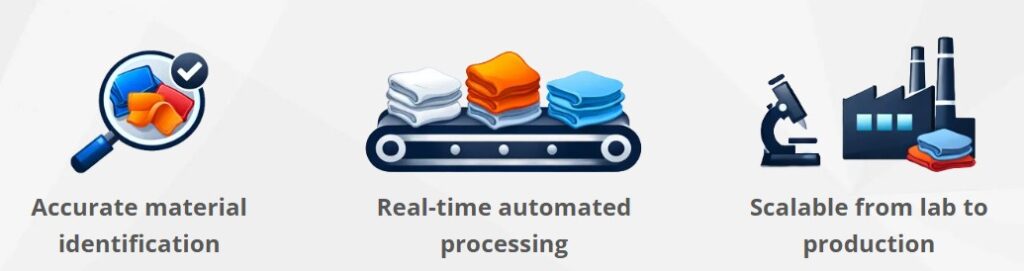
This is critical because contamination is one of the biggest barriers to fibre-to-fibre recycling. Even small amounts of mixed material can ruin recycling output streams and reduce material value dramatically.
The platform is modular, meaning it can be integrated into existing recycling lines or deployed within larger automated facilities.
Business Value for Textile Recyclers
Hyperspectral imaging enables textile recyclers to improve output quality, reduce manual work, and stay aligned with regulatory and market demands.
- Delivers purer recycling streams with higher resale value
- Cuts manual labor costs and speeds up processes
- Ensures compliance with recycling regulations
- Supports sustainability goals and ESG performance
- Strengthens brand reputation with reliable quality assurance
The technology is already being used commercially.
Spanish recycling company PICVISA integrated Specim’s hyperspectral systems into its automated textile sorting lines at the Coleo Recycling facility in Galicia, where approximately 5,000 tonnes of textile waste are processed annually.
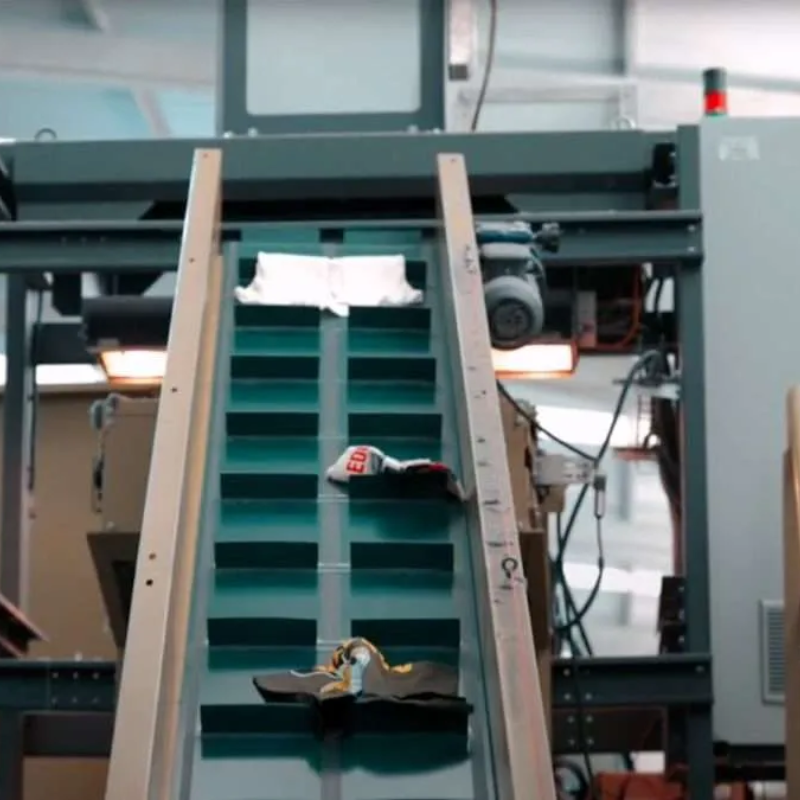
Daniel Carrero, Technical Director at PICVISA, described the system as:
“A game-changer” for textile pre-selection.
“It enables us to identify materials and compositions of garments for pre-selection before recycling, providing a complete analysis with excellent spectral resolution.”
That statement reflects a wider industry shift: intelligent sorting is no longer viewed as a support technology — it is becoming core infrastructure for the circular textile economy.
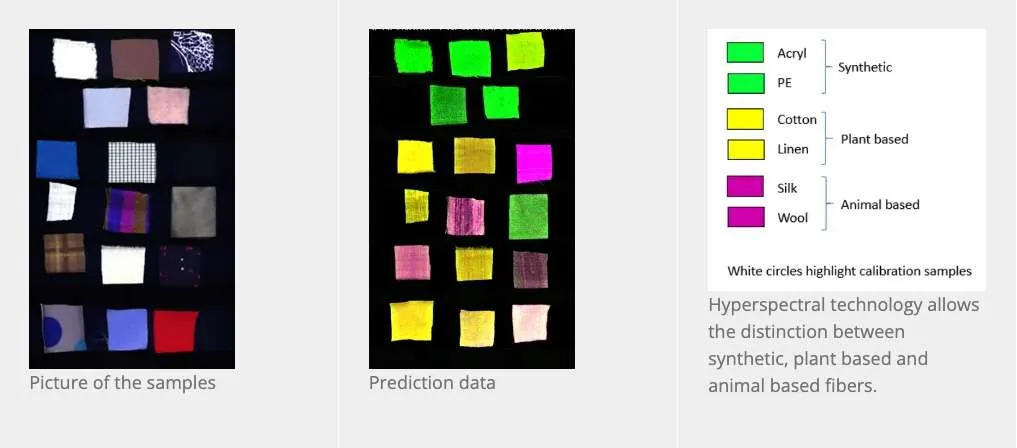
Hyperspectral identification of textile samples. Left: Picture of the fabric samples used in the test. Middle: Prediction data showing material classification based on hyperspectral imaging. Right: Colour legend distinguishing between synthetic (acryl, PE), plant-based (cotton, linen), and animal-based (silk, wool) fibres.
Other Emerging Solutions
While hyperspectral sorting is critical, it is only one part of the broader solution landscape.
1. Chemical Recycling
Chemical recycling breaks fibres down to the molecular level and rebuilds them into new textile-grade material.
This approach is especially promising for polyester and cellulose-based fibres. However, chemical recycling requires highly pure input streams — making advanced sorting technologies even more important.
2. Mechanical Recycling Improvements
Mechanical recycling remains cheaper than chemical methods but damages fibres during shredding. New machinery aims to reduce fibre degradation and improve output quality.
3. Digital Product Passports
Future garments may contain scannable digital IDs showing fibre composition, manufacturing origin, and recyclability data.
Combined with AI sorting systems, these passports could automate textile identification almost instantly.
4. Design for Recycling
Fashion brands are increasingly under pressure to simplify garment construction.
This could mean:
- Fewer blended fabrics
- Standardised materials
- Easier-to-remove trims
- Reduced dye complexity
Will Technology Solve the Problem?
Technology alone will probably not fully solve textile waste.
Even with highly advanced sorting systems, the fashion industry still faces deeper structural problems:
- Overproduction
- Overconsumption
- Declining garment durability
- Fossil-fuel dependency
- Weak repair and resale cultures
Still, there are signs of real momentum.
Governments are regulating more aggressively. Investors are funding recycling startups. AI systems are improving rapidly. And brands increasingly recognise that consumers are demanding greater accountability.
The next decade will likely determine whether textile recycling evolves into a sophisticated circular manufacturing ecosystem or remains a niche sustainability initiative overwhelmed by fast fashion waste. What is becoming increasingly clear is that manual sorting systems built for a smaller and simpler clothing industry are no longer enough.
The future of textile recycling will depend heavily on intelligent automation, chemical identification, and AI-powered material analysis. And among the technologies leading that transition, systems like Specim RETEX may become one of the defining tools of the circular textile economy.
The full case study for PicVisa can be found in our FREE Environment Magazine, as well as more interviews, case studies, news and solutions for the future…


Solve Your Next Scientific Challenge
Looking for answers to a difficult scientific or industrial problem? Speak with our experts and let us help match your application with the ideal technology.
Please send your enquiry to Dr. Luke Nicholls by email or call (01372) 378822.