



From Space Shuttles to Fighter Jets
Modern defence platforms are increasingly built from advanced composites, bonded structures, thermal barrier coatings, and lightweight materials designed to improve performance, survivability, and fuel efficiency. But these materials also introduce a major challenge:
How do you detect hidden defects quickly, accurately, and non-destructively — especially across large or complex structures?
For aerospace and defence engineers, the problem is cruciaal. Subsurface delaminations, disbonds, impact damage, blocked cooling channels, and coating defects may not be visible externally, yet can significantly compromise structural integrity and mission readiness.
For decades, industries such as aerospace, defence, automotive, and power generation relied primarily on conventional nondestructive testing (NDT) methods including ultrasound and X-ray inspection. While these techniques remain valuable, the increasing use of advanced composites, thermal barrier coatings, bonded structures, and lightweight materials has created demand for faster, wider-area, and more flexible inspection technologies.
Traditional nondestructive testing (NDT) methods such as ultrasound and X-ray remain valuable, but they often present operational limitations:
- ultrasound can be slow for large-area inspections,
- many techniques require contact or couplants,
- complex geometries can be difficult to inspect,
- and field deployment may require multiple systems and specialist operators
As aircraft fleets, propulsion systems, and advanced defence materials become more sophisticated, organisations are increasingly looking for faster, scalable inspection technologies that reduce downtime while improving defect detection capability.
At the forefront of this field is Thermal Wave Imaging (TWI), a Michigan-based company whose innovations have helped redefine modern thermographic NDT for aerospace and defence applications. Supported through multiple United States Department of Defense SBIR/STTR programs, TWI has developed advanced inspection systems now used in applications ranging from aircraft composite inspection to turbine blade analysis and space vehicle safety programs.
The company’s innovations also contributed to inspection efforts associated with NASA’s Return to Flight activities following the Columbia Space Shuttle disaster.
The Challenge: Faster Inspection Without Compromising Reliability
Whether inspecting fighter aircraft composites, turbine engine components, rotor blades, thermal protection systems, or advanced bonded assemblies, defence organisations face the same core questions:
- How can we inspect larger areas in less time?
- How do we identify hidden damage before catastrophic failure occurs?
- Can inspection be performed directly on the aircraft or platform?
- How do we reduce maintenance downtime while improving readiness?
- Can we automate inspection and reduce operator dependency?
- How do we quantify defects rather than relying on subjective interpretation?
Thermographic NDT provides a powerful answer.
Using controlled thermal stimulation and high-performance infrared imaging, thermographic inspection systems analyse how heat propagates through a material. Hidden flaws disrupt heat flow patterns, allowing defects beneath the surface to be detected rapidly and non-destructively.
Unlike conventional point-by-point inspection methods, thermography enables fast, wide-area inspection with minimal contact and high throughput.

Supporting Aerospace and Defence Readiness
The defence sector increasingly relies on lightweight composite materials to improve fuel efficiency, survivability, and performance. However, composites introduce inspection challenges that conventional techniques can struggle to address efficiently over large surfaces.
Aircraft structures, rotor blades, radomes, thermal protection systems, and bonded assemblies all require inspection for hidden defects that may not be visible externally.
Thermal Wave Imaging systems were developed specifically to address these kinds of challenges.
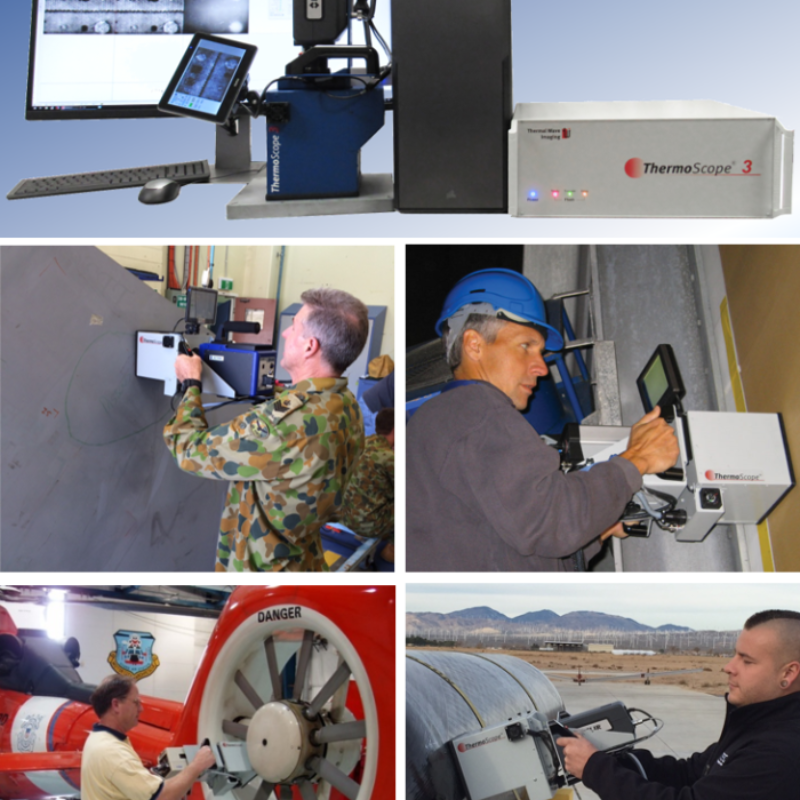
One of the company’s earliest successes came through a U.S. Navy SBIR contract that led to the development of ThermoScope®, a portable thermographic inspection platform designed to move advanced thermography out of the laboratory and onto the inspection floor.
The system enabled inspectors to perform rapid, wide-area inspections in operational environments using a lightweight, portable setup. Compared with point-by-point ultrasonic scanning, ThermoScope significantly reduced inspection times while improving the ability to detect subsurface defects across large composite structures.
Today, thermographic NDT is used across numerous aerospace and defence applications including:
- aircraft composite inspection,
- bonded structure validation,
- impact damage detection,
- corrosion monitoring,
- turbine component inspection,
- thermal barrier coating analysis,
- and advanced materials research.
The technology also played an important role in NASA’s Return to Flight efforts following the Columbia Space Shuttle disaster, helping support inspection of reinforced carbon-carbon and thermal protection system structures.
Lab Performance in a Compact Package
Advanced Thermographic NDT for Aerospace and Defence
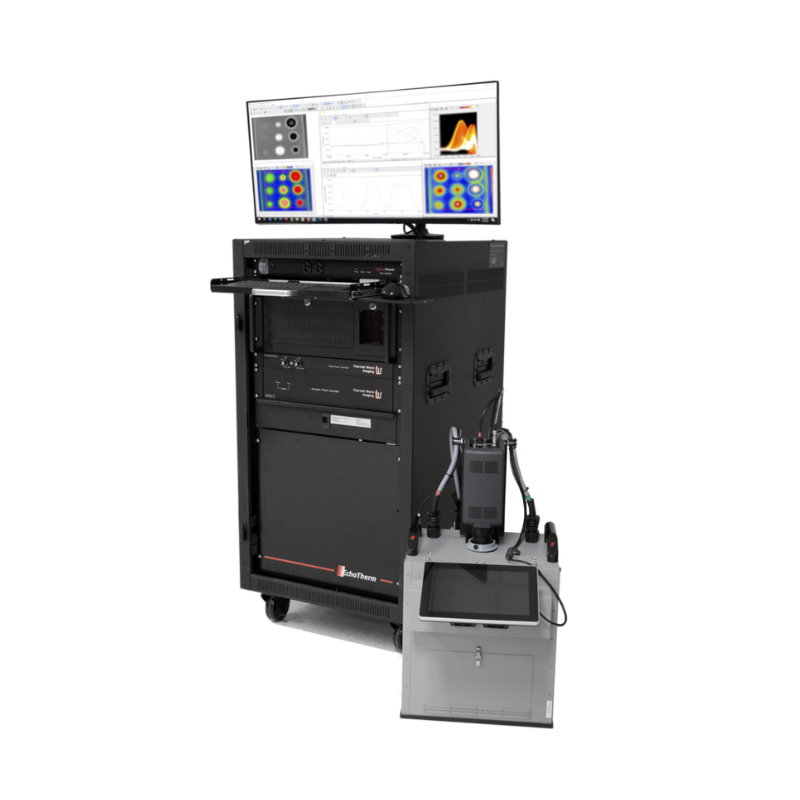
For laboratory, manufacturing, and high-performance inspection environments, EchoTherm® has become one of the leading thermographic NDT platforms available today.
Designed specifically for demanding aerospace and defence applications, EchoTherm combines:
- pulsed thermography,
- advanced infrared imaging,
- quantitative defect analysis,
- and automated inspection capability
… into a flexible inspection solution for both research and industrial deployment.
The system is particularly effective for:
- aerospace composite inspection,
- bonded structure validation,
- thermal barrier coating evaluation,
- additive manufacturing inspection,
- turbine component analysis,
- and advanced materials research.
Unlike traditional thermography systems that rely heavily on operator interpretation, EchoTherm incorporates Thermal Wave Imaging’s patented Thermographic Signal Reconstruction® (TSR®) technology to enhance flaw visibility and improve quantitative analysis.
This enables users to determine:
- defect depth,
- defect area,
- thermal diffusivity,
- coating consistency,
- and material property variations.
For defence manufacturers and research laboratories, this means faster and more repeatable inspection with actionable engineering data rather than simple thermal imagery.
EchoTherm is especially valuable in environments where:
- automated QA is required,
- large volumes of components must be inspected,
- or advanced materials require high-sensitivity defect detection.
Its compatibility with automated workflows also supports the growing defence focus on digital manufacturing and predictive maintenance strategies.
EchoTherm is especially valuable in environments where:
- automated QA is required,
- large volumes of components must be inspected,
- or advanced materials require high-sensitivity defect detection.
Its compatibility with automated workflows also supports the growing defence focus on digital manufacturing and predictive maintenance strategies.

Portable Inspection for Real-World Operations

The benchmark system for Thermographic NDT
While EchoTherm excels in laboratory and production environments, many defence organisations face another challenge entirely:
How do you bring advanced inspection capability directly to the aircraft, hangar, depot, or operational environment?
ThermoScope® was developed specifically to solve this problem.
Originally supported through U.S. Navy SBIR funding, ThermoScope was designed to move advanced thermographic inspection from controlled laboratory environments onto the inspection floor and into field operations.
The result is a lightweight, portable thermographic inspection system capable of rapid, real-time inspection of aerospace structures and defence components.
ThermoScope enables maintenance and inspection teams to perform:
- large-area composite inspections,
- impact damage detection,
- disbond identification,
- moisture ingress inspection,
- and structural integrity assessment
… without extensive disassembly or lengthy scanning procedures.
For in-service aircraft inspection, this can significantly reduce downtime while improving inspection coverage and throughput.
Because the system is portable and designed for operational flexibility, ThermoScope is particularly useful for:
- flight-line maintenance,
- depot inspection,
- deployed maintenance operations,
- rotor blade inspection,
- and hard-to-access aerospace structures.
In many cases, a single operator can rapidly assess areas that would otherwise require much longer inspection cycles using conventional methods.
Proven in Aerospace and Defence Applications
Thermal Wave Imaging technologies are not experimental concepts confined to research laboratories. They have already been applied across demanding aerospace and defence programs.
TWI’s thermographic inspection technologies have supported:
- military aircraft inspection,
- turbine airfoil analysis,
- aerospace composite validation,
- advanced manufacturing QA,
- and NASA space vehicle inspection programs.
As mentioned previously, the company’s advancements played a key role in the inspection protocols developed for NASA’s Return to Flight program, following the Columbia disaster.
Thermography and the Future of Defence Research
As defence systems continue evolving, thermographic NDT is becoming increasingly important in areas such as:
- hypersonic materials,
- ceramic matrix composites (CMCs),
- additive manufacturing,
- stealth coatings,
- digital twins,
- and predictive maintenance.
Modern defence researchers are not simply asking whether a component contains a defect. They increasingly need to quantify material behaviour, monitor degradation over time, and integrate inspection data into lifecycle management systems.
Advanced thermographic NDT systems provide a unique combination of:
- speed,
- portability,
- non-contact operation,
- wide-area inspection,
- and quantitative analysis.
These capabilities position thermography as a vital enabling technology for next-generation aerospace and defence programs.
Explore Thermographic NDT with Quantum Design UK and Ireland
Researchers, engineers, and aerospace organisations across the UK and Ireland can access Thermal Wave Imaging technologies through Quantum Design UK and Ireland.
Quantum Design UK and Ireland provides access to:
- EchoTherm® advanced thermographic NDT systems,
- ThermoScope® portable inspection solutions,
- thermographic materials characterisation tools,
- and specialist expertise for aerospace, defence, composites, and advanced manufacturing applications.
For organisations exploring:
- composite inspection,
- aerospace maintenance,
- turbine inspection,
- additive manufacturing validation,
- defence materials research,
- or advanced thermographic NDT workflows,

Dr. Shayz Ikram at Quantum Design UK and Ireland can help identify the most suitable thermographic solution for your research or operational requirements. Email or call (01372) 377882 to have a chat about your application.


