Magneto-Optics in Quantum Light and Matter 2025: A Growing Hub for Collaboration and Cutting-Edge Discovery
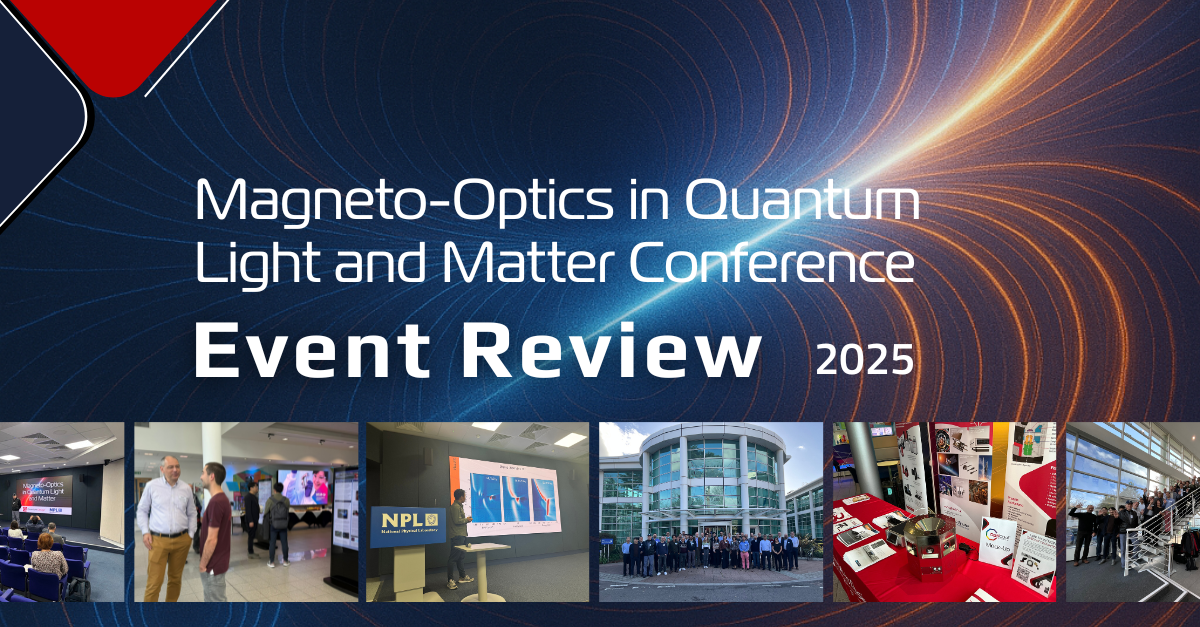
The Magneto-Optics in Quantum Light and Matter conference returned this year with renewed energy, expanded participation, and an unmistakable sense of momentum across the quantum research community. Hosted at the National Physical Laboratory (NPL) and organized in partnership with Quantum Design, the two-day event brought together leading scientists exploring the frontiers of magneto-optics — from high magnetic fields and cryogenic temperatures to ultrafast light–matter interactions.


Nathaniel Huáng, PI in Quantum Light and Matter, NPL
“I’m truly delighted to share the success of our fantastic Magneto-Optics in Quantum Light and Matter conference hosted at National Physical Laboratory (NPL). As one of the organisers and the local host, I couldn’t be happier to see the energy, curiosity, and collaborative spirit that everyone has brought to this conference.
A heartfelt thank you to all our 30+ presenters and session chairs from 12 countries across Europe, North America, and Asia for sharing such exceptional magneto-optics research. Your contributions showcased the depth and momentum of this vibrant community. Thank you to all the 60 attendees – your enthusiasm, engagement, questions, and support have created a vibrant space for discussion and discovery, making this conference truly alive. I’m leaving these two days feeling genuinely inspired and excited to imagine where we’re heading next!”


“Last week we spent two highly inspiring days at Magneto-Optics in Quantum Light and Matter conference hosted at National Physical Laboratory (NPL).
The event gathered over 60 participants from 12 countries across Europe, North America and Asia. There were more than 30 presenters sharing results of their professional magneto-optics research. Thanks to space for talks and discussion, full of collaborative spirit, the conference was really successful.ENSEMBLE3 sp. z o. o. was represented by the President Dorota A. Pawlak and Dr. Monika Tomczyk, who also gave her talk on the second day of the conference.”


Sessions:
- Nearfield Magneto-Optics, Landau-Level Nanoscopy Chair: Dmitri Basov (Columbia University, USA)
- Antiferromagnets, Magnonics Chair: Alexey Kuzmenko (University of Geneva, Switzerland)
- Excitons and Quantum Light – part I Chair: Nathaniel Huáng (National Physical Laboratory, UK)
- Special and Contributed Talks Chair: Luke Nicholls (Quantum Design)
- Ultrafast Dynamics of Quantum Matter Chair: Mengkun Liu (Stony Brook University, USA)
- Towards Quantum Technologies: Sensing, Communication, Computing Chair: Nathaniel Huáng (National Physical Laboratory, UK)
- Topological States and Topological Magnetism Chair: Alexey Kuzmenko (University of Geneva, Switzerland)
- van der Waals Magnets Chair: Mengkun Liu (Stony Brook University, USA)
- Excitons and Quantum Light – part II Chair: Nathaniel Huáng (National Physical Laboratory, UK)
Feedback
Now in its second year, the meeting has quickly become a focal point for researchers developing new techniques and technologies to probe quantum materials. Participants repeatedly emphasized how valuable it was to engage in focused, topical discussions with peers. As one attendee put it, the event enabled “very interesting discussions with other participants, and maybe even a new collaboration.” Another highlighted the opportunity to gain “knowledge of new colleagues and of their activities,” while a third noted that “very active work [is] ongoing worldwide on 2D materials.” The format itself received praise, with one participant adding, “Such topical meetings are a very nice format.”

This enthusiasm was shared by the event’s organizers. Reflecting on the success of the conference, Dr Stefano Spagna of Quantum Design International, a member of the organising committee, emphasized the scientific depth and collaborative spirit that defined the meeting:
“The Magneto-Optics in Quantum Light and Matter event – our second such conference – brought together a truly world-class line-up of speakers probing the most cutting-edge research areas of magneto-optics: high magnetic fields, cryogenic temperatures, ultrafast timescales. As one of the organizers, I was particularly proud of the opportunity to open up NPL’s Qlimate facility, showcasing Quantum Design’s OptiCool system and how advanced instrumentation drives cutting-edge quantum science. The collaborative spirit over the two days, the inspiring science, and the formation of new partnerships make me confident that we have once again laid the groundwork for many exciting developments in quantum measurement and magneto-optical research. I look forward to seeing the long-term impact of these conversations on both fundamental physics and future technology.”

The conference also benefited from the involvement of Luke Nicholls, Acting Managing Director of Quantum Design UK and Ireland, who chaired the Special and Contributed sessions. He underscored the atmosphere of innovation and connection that shaped the event:
“I was honoured to be on the organising committee at this year’s Magneto-Optics in Quantum Light and Matter conference, and chair the Special and Contributed. Over the two days at NPL, it became clear how deeply the quantum research community is pushing the boundaries of what’s possible — from ultrafast light–matter interactions to extreme-field magneto-optical phenomena.
The guided tours of NPL’s Qlimate facility and the OptiCool instrumentation — made for a truly inspiring and collaborative atmosphere. It was a privilege to see first-hand how our OptiCool platform is enabling world-class research at cryogenic temperatures and high magnetic fields.
Moreover, hosting the dinner with so many leading researchers gave us a chance to reflect, laugh, and build connections that I believe will fuel new collaborations long into the future. Events like this underscore the importance of bringing together innovators from academia and industry — not just to share knowledge, but to imagine what’s next in quantum science.”


Celebrating Outstanding Research
A highlight of the conference was the recognition of exceptional contributions from early-career and senior researchers alike.
- The Best Contribution Prize was awarded to Robin Nicholas (University of Oxford) for his talk, “Magneto-optical spectroscopy of single photon emission from new exciton states in Cove edged individual graphene nanoribbons.”
- The Poster Prize went to Bei Sun of the International MegaGauss Science Laboratory, Institute for Solid State Physics at the University of Tokyo, for the poster “Giant Magneto-Optical Response in LiNiPO₄ under Pulsed High Magnetic Fields.”
- Runner-up Poster Prize was awarded to Zhe Li (Heriot-Watt University) for the work “Band Structure and Confined Interlayer Excitons in Switchable Ferroelectric R-WSe₂ Bilayers.”
These presentations showcased the diversity of research advancing the field — from nanoribbon-based quantum emitters to pulsed-field magneto-optical phenomena and reconfigurable excitonic materials.


Looking Ahead
With discussions ranging from new instrumentation techniques to the next generation of quantum materials, the conference reaffirmed the vital role of collaboration between academia, national laboratories, and industry. The shared insights, new partnerships, and emerging ideas signal a bright future for magneto-optical science.
As momentum builds and the community grows, the Magneto-Optics in Quantum Light and Matter event is poised to continue shaping the direction of the field — inspiring innovation today and setting the stage for breakthroughs tomorrow.
Special thanks to our sponsors:

If you have any questions about the OptiCool, or would like to register your interest in attending future events like this, please get in touch with Dr. Luke Nicholls, by email below or call (01372) 378822.
Quantum Design OptiCool® Optical Cryostat
The cryogen-free OptiCool platform leverages Quantum Design’s 40+ years’ experience in engineering and manufacturing automated temperature and magnetic field control systems. With fully automated cooldown and seamless temperature control through the range of 350 K to 1.7 K, the OptiCool platform also has the low vibration and stability that is critical to optical measurements.