

The United Kingdom, like much of the world, is currently experiencing the effects of a significant helium shortage. It is a critical industrial gas with no viable substitute in many high-tech and medical applications. This shortage is not an isolated UK issue but part of a global supply crisis driven by geopolitical, economic, and structural factors.
Causes of the Helium Shortage
One of the primary reasons behind the helium shortage is the concentration of global supply. Helium is not produced independently; it is a by-product of natural gas extraction. This means its availability is tied directly to natural gas production levels and infrastructure. A large proportion of global helium supply comes from a small number of regions, particularly Qatar, which accounts for a significant share of global output.
Recent geopolitical tensions, especially in the Middle East, have severely disrupted production and export routes. Conflict in the region has led to shutdowns of key facilities and logistical bottlenecks, tightening supply worldwide.
In addition, helium is difficult to store and transport. Due to its extremely low boiling point and small atomic size, it can escape even from advanced containment systems, meaning stockpiling is limited and supply chains operate with minimal buffer.
At the same time, demand for helium has increased significantly. Growth in sectors such as semiconductors, healthcare imaging, aerospace, and quantum technologies has intensified pressure on already constrained supply.
Who/What is Affected?
The helium shortage has far-reaching consequences across multiple critical industries in the UK:

Healthcare | Semiconductors | Aerospace
- Healthcare
- Helium is essential for cooling superconducting magnets in MRI scanners. Reduced supply can delay diagnostic procedures and impact patient care.
- Semiconductors and Electronics
- Helium is used in chip manufacturing for cooling and leak detection. Shortages risk slowing production of electronics, vehicles, and AI hardware.
- Scientific Research
- Universities and laboratories rely on liquid helium for cryogenic experiments, particularly in physics and quantum computing. A lack of supply can halt research entirely.
- Aerospace and Defence
- Helium is used in rocket systems, pressurisation, and testing. Supply constraints can affect both commercial and defence capabilities.
- Fibre Optics and Manufacturing
- Helium plays a role in producing fibre optic cables and precision manufacturing processes, impacting telecommunications infrastructure.
Because helium is non-substitutable in many of these applications, shortages can lead not just to higher costs but to complete operational shutdowns in some cases.
Overcoming the Challenge: The Role of Helium Liquefiers
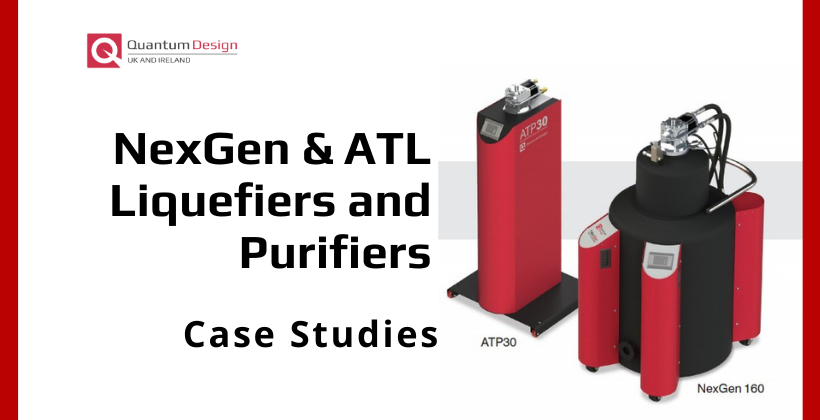
In response to ongoing shortages, organisations are increasingly turning to helium recovery, recycling, and liquefaction technologies to reduce dependence on external supply chains. This is where advanced systems such as Quantum Design’s NexGen helium liquefiers become highly relevant.
These systems are designed to capture helium gas that would otherwise be lost during operation, purify it, and reliquefy it for reuse. This creates a closed-loop system that significantly reduces helium consumption and mitigates the impact of supply disruptions.

Key benefits include:
- Supply Independence
- By recycling helium on-site, institutions are less reliant on volatile global supply chain
- Cost Reduction
- Recovering and reusing helium reduces the need for expensive external purchases, particularly during price spikes.
- Operational Continuity
- Critical systems such as MRI scanners and cryogenic research equipment can continue functioning without interruption.
- Sustainability
- Minimising helium loss helps conserve a finite and non-renewable resource.
For UK universities, hospitals, and high-tech manufacturers, such systems represent a strategic investment. Rather than being vulnerable to global shortages, organisations can take control of their helium usage and ensure long-term resilience.

Conclusion
The helium shortage in the UK is a complex issue rooted in global supply constraints, geopolitical instability, and rising demand from advanced industries. Its impact spans healthcare, technology, research, and manufacturing—sectors that are vital to both economic growth and societal wellbeing.
While the shortage is unlikely to be resolved quickly, technological solutions such as helium recovery and liquefaction systems offer a practical and effective way forward. By adopting these innovations, UK organisations can not only mitigate current challenges but also future-proof their operations against ongoing supply uncertainty.
Discover the Quantum Design solutions to this UK and worldwide problem…
Have an informal chat today…
To discuss your application and helium challenges/worries, please get in touch with Dr. Shayz Ikram, our Technical Director, by email below or call (01372) 378822…