

In the demanding world of high-energy physics, where massive particle accelerators and superconducting systems push the limits of engineering and science, precise measurement of cryogenic temperatures is essential. The Lake Shore Cryotronics application note titled “Cernox™ Resistance Temperature Sensors for High Energy Physics Applications” addresses this challenge by highlighting the performance and suitability of Cernox sensors for monitoring thermal conditions in the most extreme environments found in modern accelerator facilities.
High-energy physics experiments, such as those conducted at CERN’s Large Hadron Collider (LHC), involve superconducting magnets operating at temperatures close to absolute zero. These magnets must remain stable and uniform in temperature to ensure reliable and safe operation. Even slight thermal fluctuations can lead to a quench—a sudden loss of superconductivity that can damage equipment and halt experiments. Accurately detecting tiny temperature changes in such conditions requires sensors with exceptional sensitivity, stability, and durability.
What Are Cernox™ Sensors?

Cernox sensors are thin-film resistance temperature detectors (RTDs) developed and manufactured by Lake Shore Cryotronics. Unlike traditional bulk or thick-film sensors, these devices use a zirconium nitride/zirconium oxide thin-film on a sapphire substrate to provide high sensitivity across a wide temperature range, from as low as 0.1 K up to several hundred Kelvin, depending on the model.
Key attributes of Cernox sensors include low magnetic field-induced errors, excellent radiation resistance, and fast thermal response times—all critical characteristics in high-energy physics environments, where sensors may be exposed to intense magnetic fields (often exceeding 10 T) and significant cumulative radiation doses over the lifetime of the experiment.
Designed for Extreme Environments
The application note underscores that traditional temperature sensors often fall short in cryogenic, high radiation, and high field environments. Platinum RTDs, for instance, are stable but limited to temperatures above ~13 K. Germanium thermometers, while sensitive, are restricted to below ~100 K and can be compromised by magnetic fields. Carbon-glass devices tolerate magnetic fields but lack long-term stability. Cernox sensors were conceived explicitly to bridge these gaps, offering balanced performance across temperature range, magnetic environment, and long-duration stability.
The document details how Cernox sensors maintain calibration integrity even after extensive thermal cycling and prolonged storage, with average calibration drift measured at just a few millikelvin over years of non-use. It also presents data on magnetic field-induced calibration shifts, demonstrating that readings remain accurate within a few percent even under high field conditions.

Another critical performance metric is response time. In accelerator systems, where localised heating can rapidly propagate and cause quenching, the ability to detect temperature changes within milliseconds can mean the difference between prevention and catastrophic failure. Cernox sensors exhibit rapid thermal response, with characteristic times in the millisecond range.
Summary
The Lake Shore application note makes a compelling case for the use of Cernox resistance temperature sensors in high-energy physics and related cryogenic applications. Their combination of wide operating range, radiation hardness, magnetic field insensitivity, fast response, and long-term stability positions them as an indispensable tool for researchers and engineers working on cutting-edge scientific experiments involving superconducting systems.
Discover the Cernox Temperature Sensor Range
Cernox® thin film resistance cryogenic temperature sensors offer significant advantages over comparable bulk or thick film resistance sensors.
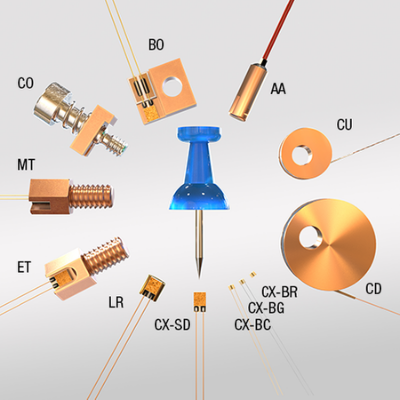

Do you have questions about Lake Shore Temperature Sensors?
Get in touch with our Technical Sales Engineer, Michael Barr, by email below, or call (01372) 378822.
You Might Also Like…
WATCH NOW: Cryogenic Temperature Sensors Installation Techniques for Success
Interested in knowing more about how to correctly install a sensor in a cryogenic application and to avoid common installation errors? Then watch this recording of an Institute of Physics (IOP) webinar presented by Dr. Scott Courts, Lake Shore Senior Scientist.