



This application note demonstrates how Photo-induced Force Microscopy (PiFM), used in Molecular Vista’s Vista Series microscopes, enables nanoscale chemical characterisation of surface functionalisation—particularly for detecting issues in supposed monolayer coatings.
Background
Surface functionalisation is widely used to control how molecules (e.g., proteins, DNA, bacteria) interact with materials. Success depends on forming a uniform monolayer of functional groups. However, contamination or incomplete coverage can lead to unreliable results and is difficult to diagnose with conventional tools.
Limitations of Traditional Techniques
Common methods like:
- ToF-SIMS (destructive),
- XPS (requires vacuum),
- Water contact angle (non-specific),
lack the combination of high spatial resolution, chemical specificity, and non-destructive analysis needed to evaluate monolayers effectively.
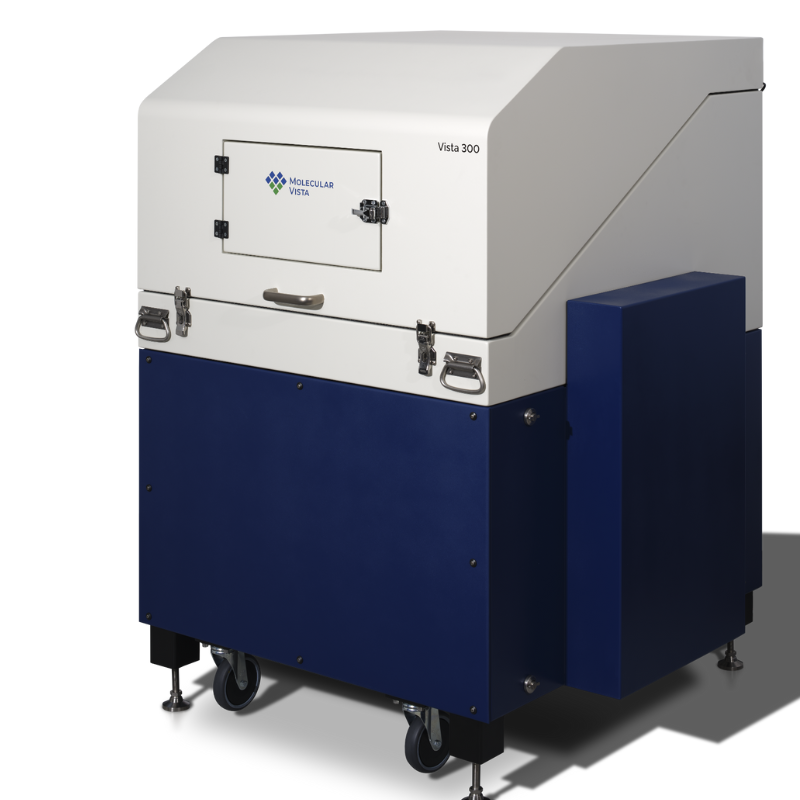
Advantage of PiFM
PiFM provides:
- Sub-5 nm spatial resolution
- Sub-monolayer sensitivity
- Chemical identification via IR absorption
- Operation in ambient conditions
This makes it ideal for detecting chemical composition and uniformity at the nanoscale.
Key Findings from Case Studies
1. Aminosilane on Glass
- Expected: uniform aminosilane monolayer
- Observed:
- Surface had organic contamination even before treatment
- After functionalisation, aminosilane formed clusters (aggregates) instead of a uniform layer
- Large areas remained bare or only contaminated
- Insight: Functionalisation process was inefficient and non-uniform

2. Epoxide Silane on Silicon Oxide
- Expected: continuous silane coating
- Observed:
- Similar clustered (“island-like”) structures
- Only some molecules bonded to the surface; others formed Si–O–Si linked aggregates
- Supports literature suggesting silanes form “snow mogul”-like clusters, not flat monolayers
Overall Conclusion
- In both cases, monolayers failed to form as intended
- Instead, coatings formed non-uniform clusters, leaving significant portions of the substrate exposed
- This can negatively impact device performance, reproducibility, and reliability
Key Takeaway
PiFM is a powerful tool for:
- Verifying surface functionalisation quality
- Detecting contamination and coating defects
- Troubleshooting failed surface chemistry processes

Learn More
For further information and to discuss your application, please get in touch with QDUKI’s Technical Director, Dr. Shayz Ikram by email below or call (01372) 378822.


