

- Models
- Options
- Publications
- Options
- Specifications
- Videos
- Downloads
- Applications
- Related Products
- Contact
- Back To Spectroscopy
- Back To Optics
- Back To Hyperspectral
- Back To Cameras
- Back To X-Ray
- Back To Light Measurement
- Back To Characterisation
- Back To Electron Microscopy
- Back To Magnetometry
- Back To Ellipsometers
- Back To Cryogenics
- Back To Lake Shore
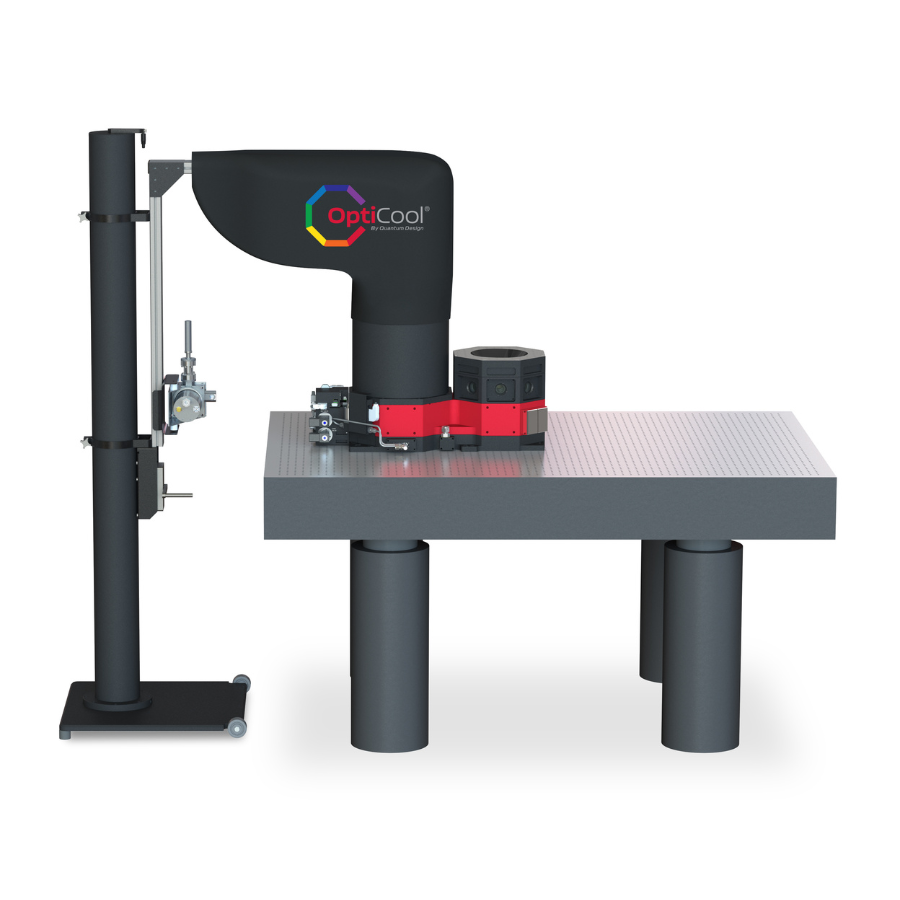


Closed-Cycle Optical Cryostat
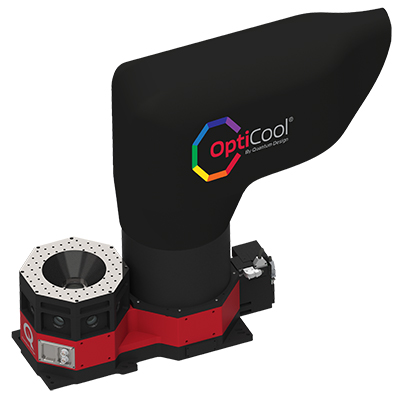
OptiCool® Cryogen-Free Optical Cryostat Family
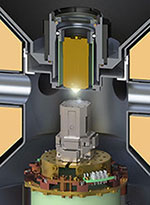
OptiCool® is a family of cryogen-free, closed-cycle optical cryostat systems designed for low-temperature optical and magneto-optical measurements. Systems are available in standard 7 tesla magnet, vector magnet, and magnet-free configurations to support a wide range of experimental requirements.
These cryostat systems provide fully automated cooldown and precise temperature control from 350 K to 1.7 K, along with stable, low-vibration performance required for sensitive optical measurements. Making it ideal for magneto-optical spectroscopy, Raman spectroscopy, and photoluminescence measurements The integrated magnet design of the 7 Tesla and Vector configurations places the sample at the center of the optical environment, enabling magneto-optical measurements with unobstructed, multi-directional optical access and precise magnetic field orientation relative to the sample. The OptiCool leverages Quantum Design’s 40+ years’ experience in engineering and manufacturing automated temperature and magnetic field control systems.
With a large, configurable sample space and flexible optical access, OptiCool supports advanced experimental setups for spectroscopy, microscopy, and materials characterisation under controlled temperature and magnetic field conditions. The magnet-free Flex configuration further expands experimental flexibility while providing a 4 K thermal bus for additional cooled components.
OptiCool’s configurable sample pod architecture supports customised optical setups, including experiments extending beyond the primary instrument volume. Multiple side-window configurations, optional bottom optical access, and custom wiring configurations provide additional flexibility for advanced experimental designs.
Cryostat for optical experiments
- Colour Centres (e.g., Diamond Nitrogen Vacancies)
- Quantum Optics
- 2D Materials (e.g., Transition Metal Dichalcogenides)
- Spintronics
- AFM / Microscopy
- MOKE / CryoMOKE
- Raman / FTIR Spectroscopy
- UV / VIS Reflectivity & Absorption
- Time Resolved Magnetic Spectroscopy
- Magneto-Excitons
- Anisotropic Magnetic Single Crystals
- Magnetic Thin Films
Profile

Profile
Profile

Profile

Profile

Profile

Profile

MODELS
OptiCool® 7 Tesla
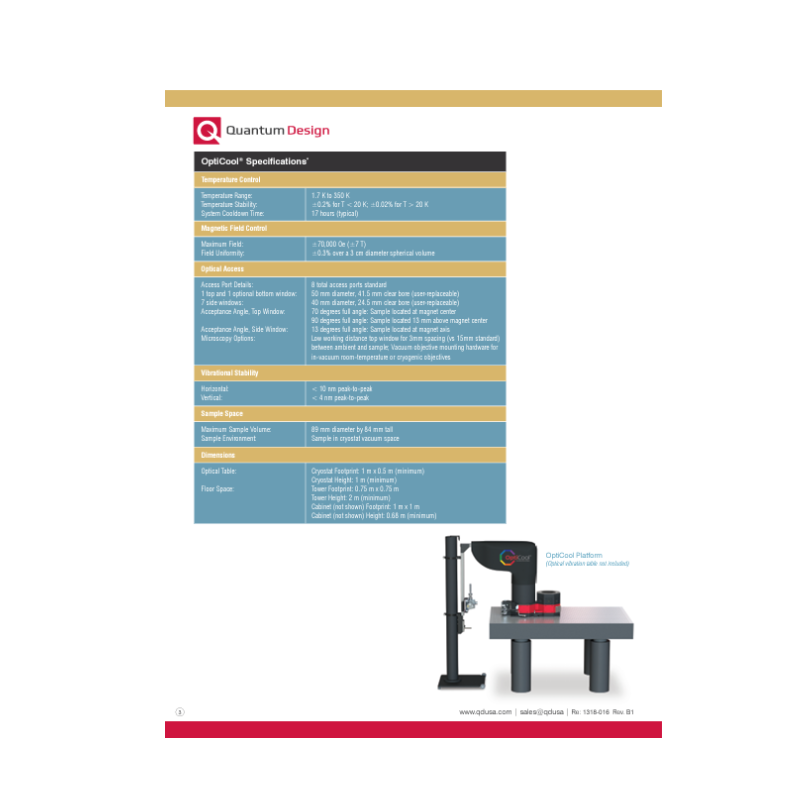
The standard OptiCool 7 Tesla optical cryostat features a ±7 tesla split-conical superconducting magnet with field perpendicular to the optical table and high field uniformity (±0.3% over a 3 cm diameter spherical volume). Seven side optical windows provide multi-directional optical access to a large experimental volume while maintaining uniform magnetic field conditions for magneto-optical measurements.
- Magnetic Field:
- 7 T Split-Coil Conical Magnet
- Optical Access Ports8 Ports:
- 7 Side Ports (NA > 0.11)
- 1 Top Port (NA > 0.7)
- Optional Bottom Port
- Sample Volume:
- 84 × 89 mm
- Automated Temperature & Magnet Control
- Cryogen Free
| Temperature Range: | 1.7 K – 350 K | ||
| Low Vibration: | <10 nm peak-to-peak | ||
| Temperature and Magnet Control: | Automated | ||
| Cryogen: | Cryogen Free | ||

OptiCool® Vector
The OptiCool Vector magneto-optical cryostat provides magnetic fields up to ±4 T perpendicular to the optical table and ±1 T in the plane parallel to the table. Optical access along the X, Y, and Z directions enables both in-plane and out-of-plane transmission and reflection measurements, while vector magnet control allows precise alignment of the magnetic field relative to the sample and optical system.
- Magnetic Field:
- 4-1-1 T Vector Magnet (Z-X-Y)
- Optical Access Ports5 Ports:
- 4 Side Ports (Along X and Y Axes)
- 1 Top Port (Along Z Axis)
- Optional Bottom Port
- Sample Volume:
- 84 × 89 mm
- Automated Temperature & Magnet Control
- Cryogen Free
| Temperature Range: | 1.7 K – 350 K | ||
| Low Vibration: | <10 nm peak-to-peak | ||
| Temperature and Magnet Control: | Automated | ||
| Cryogen: | Cryogen Free | ||

OptiCool® Flex
The magnet-free OptiCool Flex optical cryostat maximizes experimental access with a large 75 mm × 200 mm workspace volume and open optical geometry for customised low-temperature experimental setups. A 4 K thermal transfer bus, ultra-low vibration performance, and multi-directional optical access support advanced spectroscopy, microscopy, and integrated optical measurements requiring additional cooled components.
- Magnetic Field:
- None
- Optical Access Ports8 Ports:
- 7 Side Ports (NA > 0.11)
- 1 Top Port (NA > 0.7)
- Optional Bottom Port
- Sample Volume:
- 75 × 200 mm
- Automated Temperature & Magnet Control
- Cryogen Free
| Temperature Range: | 1.7 K – 350 K | ||
| Low Vibration: | <10 nm peak-to-peak | ||
| Temperature and Magnet Control: | Automated | ||
| Cryogen: | Cryogen Free | ||
Sample Pods
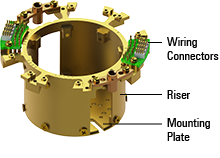
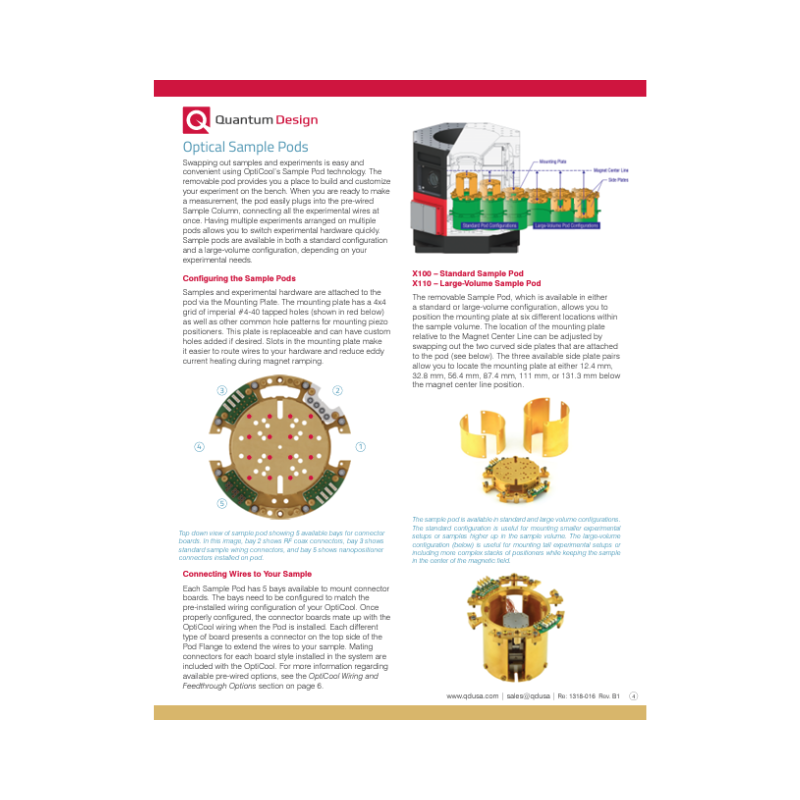
The OptiCool’s Sample Pod provides a place to build and customise your experiment on the bench. When you are ready to make a measurement, the Sample Pod easily plugs into the pre-wired temperature control column. Having multiple experiments arranged on multiple pods allows you to switch experimental hardware quickly. Sample Pods are available in both a standard configuration and a large-volume configuration depending on the experimental needs. Each type of pod can be further configured by changing the riser pieces (available in three lengths; included with the system) to adjust the height of the mounting plate.
Standard Sample Pod – Allows for mounting plate positions at 56.4 mm, 32.8 mm and 12.4 mm below the magnet centre.
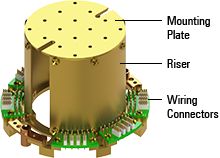
Large-Volume Sample Pod – Allows for mounting plate positions at 131.3 mm, 111.0 mm and 87.4 mm below the magnet centre.
Sample Positioning
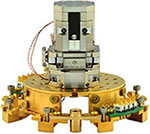
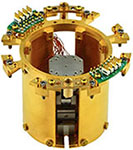
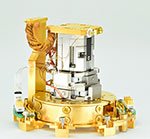
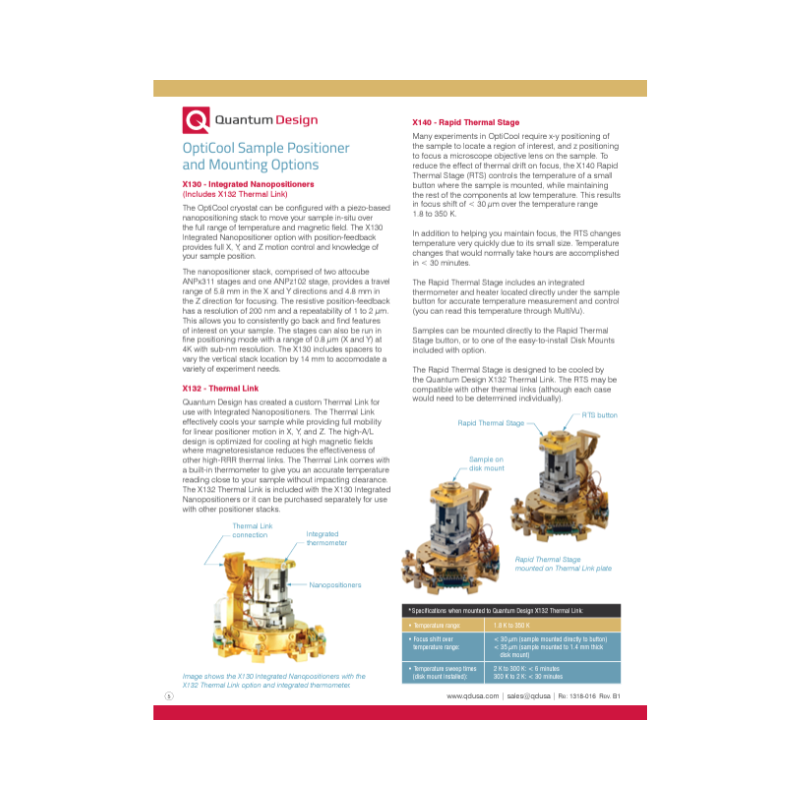
Many optical applications require precise positioning of the sample to the optical path for focusing or examination of an area of interest. The ability to scan the sample is also required for 2D imaging of sample properties. To meet these needs the OptiCool cryostat can be configured with a piezo-based nanopositioning stack to move your sample in situ. The nanopositioner option comes with all the adapters needed to mount the nanopositioners onto a pod, specialised cryostat wiring, cabling that can connect to the piezo controller, and a thermal link specifically designed for use in the OptiCool. The nanopositioner stack can be mounted on the standard pod or on the large-volume pod depending on experimental needs. Also available is a Rapid Thermal Stage that reduces the amount of time it takes to stabilise focus on your sample when ramping or changing temperature. Additionally, we offer a Wired Sample Mount that allows users to wire their samples to the 16 pads of a removable sample mount that comes equipped with a flex wiring cable that plugs easily into the sample pod.
OptiCool nanopositioner on standard pod
OptiCool nanopositioner on large-volume pod
OptiCool nanopositioner with thermal link
Windows and Objectives
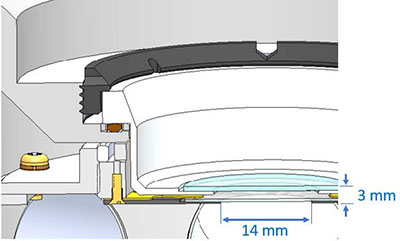
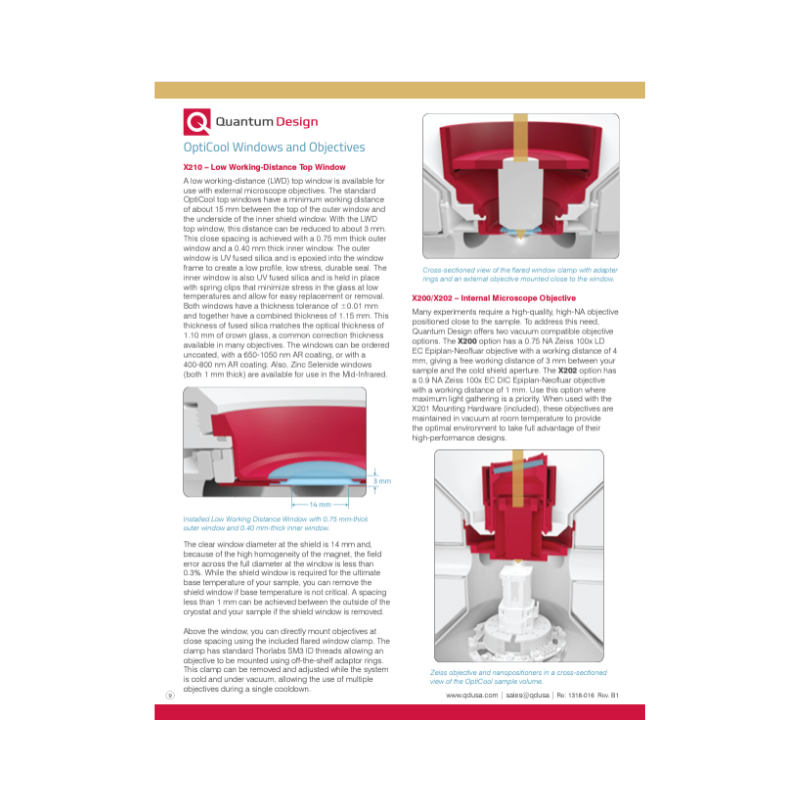
Optical experiments can require a variety of windows and microscope objectives. To address these needs Quantum Design offers window and objective configuration options, including a low working-distance top window option, vacuum objective mounting hardware, and a bottom access window. The low working-distance top window reduces the minimum working distance from 15 mm to about 3 mm between the top of the outer window and the underside of the inner shield window. The hardware allows you to directly mount a wide variety of objectives at close spacing using the included window clamp and standard off-the-shelf adaptor rings. This means you can make adjustments or swap out objectives while the sample remains cold. Quantum Design also offers a Zeiss 100x LD EC Epiplan-Neofluar, infinity-corrected objective mounted inside the cryostat. This objective offers a 0.75 NA and a working distance of 4 mm. A kit is also available to mount your own objectives in vacuum if desired. A bottom access window is available for the cryostat, allowing transmission measurements along the magnet axis, perpendicular to the surface of the optical table.
OptiCool room temperature objective
OptiCool low working-distance window
Testimonials
“Integrating the OptiCool® into my research program will allow for accessing experimental phase space in complex materials that simply wasn’t available to my group in the past. Innovative products advance science and the OptiCool certainly meets this standard.”
Prof. Richard Averitt of the Physics Department at the University of California San Diego
“A lot of my research over the years has been in the far infrared or terahertz. And so I think that the OptiCool® provides a really exciting opportunity to do novel far infrared spectroscopy on materials in a magnetic field environment.”
Prof. Richard Averitt, UC San Diego
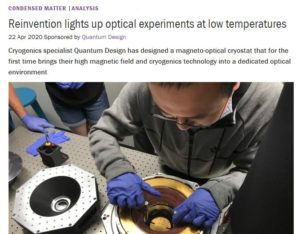
Read the Physics World article on the OptiCool
VIDEOS
Downloads



Supplier Info

Publications
2025

R. Qi et al., Perfect Coulomb drag and exciton transport in an excitonic insulator. Science 388, 278 (2025).
M. Liu, J. Zhu, G. Zhao, Y. Li, Y. Yang, K. Gao, and K. Wu, Coherent manipulation of photochemical spin-triplet formation in quantum dot–molecule hybrids. Nat. Mater. (2025).
I. Becker, M. Morganti, S. J. Groß, S. Demeshko, S. Dechert, M. John, and F. Meyer, Axial Ligand Lability and Coordination Induced Spin State Variations of Tetracarbene Iron(II) Thiolato Complexes. Eur J Inorg Chem (2025).
D. Kim et al., Observation of the magnonic Dicke superradiant phase transition. Sci. Adv. 11, (2025).
R. Jing et al., Photocurrent Nanoscopy of Quantum Hall Bulk. Phys. Rev. X 15. (2025).
2024
Kravtsov, M., Shilov, A.L., Yang, Y. et al. Viscous terahertz photoconductivity of hydrodynamic electrons in graphene. Nature Nanotechnology (2024).
Shilov, A., Kashchenko, M., Peralta, P., Wang Y., Kravtsov, M., Kudriashov, A., Zhan, Z., Taniguchi, T., Watanabe, K., Slizovskiy, S., Novoselov, K., Fal’ko, V., Guinea, F., and Bandurin, D., High-Mobility Compensated Semimetals, Orbital Magnetization, and Umklapp Scattering in Bilayer Graphene Moiré Superlattices. ACS Nano (2024).
2023
Dapolito, M., Tsuneto, M., Zheng, W. et al., Infrared nano-imaging of Dirac magnetoexcitons in graphene. Nature Nanotechnology (2023).
R. Xiong, J. H. Nie, S. L. Brantly, P. Hays, R. Sailus, K. Watanabe, T. Taniguchi, S. Tongay, and C. Jin, Correlated Insulator of Excitons in WSe2/WS2 Moiré Superlattices. Science 380, 860 (2023).
S. Xu et al., Magnetoelectric Coupling in Multiferroics Probed by Optical Second Harmonic Generation. Nat Commun 14, (2023).
J.-X. Qiu et al., Axion Optical Induction of Antiferromagnetic Order. Nat. Mater. (2023).
Y.-F. Zhao, R. Zhang, J. Cai, D. Zhuo, L.-J. Zhou, Z.-J. Yan, M. H. W. Chan, X. Xu, and C.-Z. Chang, Creation of Chiral Interface Channels for Quantized Transport in Magnetic Topological Insulator Multilayer Heterostructures. Nat Commun 14, (2023).
J. Nelson et al., Layer-Dependent Optically Induced Spin Polarization in InSe. Phys. Rev. B 107, (2023).
2022
H. Padmanabhan et al., Large Exchange Coupling Between Localized Spins and Topological Bands in MnBi2Te4. Advanced Materials 34, 2202841 (2022).
M. H. Naik, E. C. Regan, Z. Zhang, Y.-H. Chan, Z. Li, D. Wang, Y. Yoon, C. S. Ong, W. Zhao, S. Zhao, M. I. B. Utama, B. Gao, X. Wei, M. Sayyad, K. Yumigeta, K. Watanabe, T. Taniguchi, S. Tongay, F. H. da Jornada, F. Wang, S. G. Louie, Intralayer charge-transfer moiré excitons in van der Waals Superlattices. Nature. 609 (2022), pp. 52–57.
Z. Zhang, E. C. Regan, D. Wang, W. Zhao, S. Wang, M. Sayyad, K. Yumigeta, K. Watanabe, T. Taniguchi, S. Tongay, M. Crommie, A. Zettl, M. P. Zaletel, F. Wang, Correlated interlayer exciton insulator in heterostructures of monolayer WSe2 and moiré WS2/WSe2. Nat. Phys. (2022).
G. Mayonado, K. T. Vogt, J. D. B. Van Schenck, L. Zhu, G. Fregoso, J. Anthony, O. Ostroverkhova, M. W. Graham, High-Symmetry Anthradithiophene Molecular Packing Motifs Promote Thermally Activated Singlet Fission. J. Phys. Chem. C. 126 (2022), pp. 4433–4445.
J. Cenker, S. Sivakumar, K. Xie, A. Miller, P. Thijssen, Z. Liu, A. Dismukes, J. Fonseca, E. Anderson, X. Zhu, X. Roy, D. Xiao, J.-H. Chu, T. Cao, X. Xu, Reversible strain-induced magnetic phase transition in a van der Waals magnet. Nat. Nanotechnol. 17 (2022), pp. 256–261.
H. Padmanabhan, M. Poore, P. K. Kim, N. Z. Koocher, V. A. Stoica, D. Puggioni, H. (Hugo) Wang, X. Shen, A. H. Reid, M. Gu, M. Wetherington, S. H. Lee, R. D. Schaller, Z. Mao, A. M. Lindenberg, X. Wang, J. M. Rondinelli, R. D. Averitt, V. Gopalan, Interlayer magnetophononic coupling in MnBi2Te4. Nat Commun. 13 (2022).
2021
T. Song, E. Anderson, M. W.-Y. Tu, K. Seyler, T. Taniguchi, K. Watanabe, M. A. McGuire, X. Li, T. Cao, D. Xiao, W. Yao, X. Xu, Spin photovoltaic effect in magnetic van der Waals heterostructures. Sci. Adv. 7 (2021).
Y. Jia, P. Wang, C.-L. Chiu, Z. Song, G. Yu, B. Jäck, S. Lei, S. Klemenz, F. A. Cevallos, M. Onyszczak, N. Fishchenko, X. Liu, G. Farahi, F. Xie, Y. Xu, K. Watanabe, T. Taniguchi, B. A. Bernevig, R. J. Cava, L. M. Schoop, A. Yazdani, S. Wu, Evidence for a monolayer excitonic insulator. Nat. Phys. 18 (2021), pp. 87–93.